When you land in Seoul, the usual list is Gyeongbokgung, Myeongdong and N Seoul Tower. After a day or two, the questions get more specific. Which exhibitions are free right now? Where can you see the skyline without buying a ticket? Who designed the building you just walked past, and when?
This piece groups seven GHMUN.COM maps by the situation you are in. For each one it names real places, years and prices taken from the map's own data, and says which button to press. Five of the seven have an English screen, and the links below open it where possible. The other two are Korean-only, so there are notes on how to use them anyway.
Before you head to Gwanghwamun or City Hall
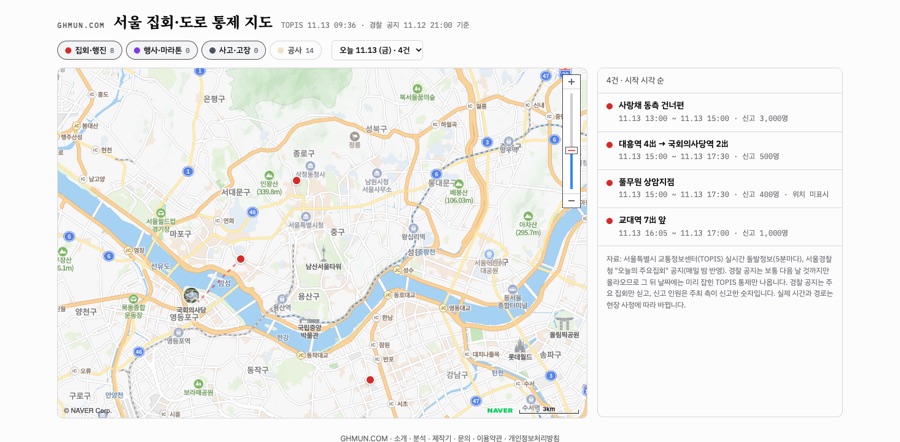
If your day goes past Gwanghwamun or City Hall, check whether the roads are closed first. The Seoul Rallies & Road Closures map puts two sources on one map: the city's live traffic incident feed (TOPIS), refreshed every five minutes, and the Seoul Metropolitan Police Agency's daily notice of major rallies, added every night.
The screen is Korean-only, but there are only a few controls. The row of chips toggles the four kinds of closure: 집회·행진 (rallies and marches), 행사·마라톤 (events and marathons), 사고·고장 (accidents and breakdowns) and 공사 (road works, off by default). The drop-down next to it picks the time: 지금 통제 중 means "closed right now", and the dated options show each of the next seven days. Tap an item in the list to see its time, the number of people the organisers registered, the police station in charge, and a link to the police notice.
As an example, the police notice fetched on the night of 12 November listed four rallies for the next day: 3,000 people opposite the east side of Sarangchae in Hyoja-dong from 13:00 to 15:00, 1,000 people outside exit 7 of Seoul Nat'l Univ. of Education Station from 16:05 to 17:00, and a 500-person march from Daeheung Station exit 4 to National Assembly Station exit 2 from 15:00 to 17:30, and 400 people outside Pulmuone's Sangam branch from 15:00 to 17:30. Marches with a start and end point are drawn as a dashed line, so you can see which streets they use.
Walking Jeongdong and Gwanghwamun, building by building
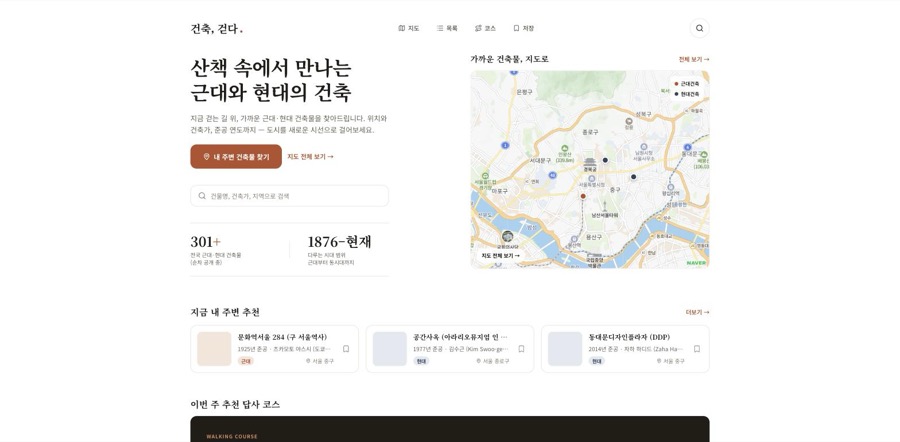
Walking Architecture has 133 modern and contemporary buildings in Seoul alone, with building notes in English (adding ?lang=en to the address switches the language; Japanese is also available). If you start at City Hall, open the "Routes" tab and pick "Jeongdong Road, a modern architecture walk". It is 1.8 km and about 50 minutes, and the map draws the stops in walking order.
- Deoksugung Seokjojeon: completed in 1910, designed by the British architect J. R. Harding. A neoclassical stone palace building.
- Deoksugung Jeonggwanheon: 1900, by A. I. Seredin-Sabatin.
- Seoul Anglican Cathedral: designed by Arthur Dixon. Construction began in 1922, it was consecrated unfinished in 1926, and it was only completed in 1996.
- Chungdong First Methodist Church: consecrated in 1897. The designer has not been confirmed.
- Seoul Museum of Art, Seosomun: the 1928 facade of the former Gyeongseong Court, with a new building behind it.
Walk north toward Gwanghwamun and the buildings get newer. The Kyobo Life building (1980) is by César Pelli, KT Gwanghwamun Building East (2015) by Renzo Piano, and Jongno Tower (1999) at Jonggak by Rafael Viñoly. The new Seoul City Hall (2012) was designed by Yoo Kerl. Tap any building for its year, architect and a short note.
Jeongdong also has old trees. The Korea Tree Map lists an 825-year-old pagoda tree at Seosomun-ro 11-gil 43 and a 520-year-old one at Jeongdong-gil 21, both protected trees designated by the city of Seoul.
For a view from above, open Seoul Sky and choose English in its language menu. The Jeongdong Observatory on the 13th floor of the City Hall Seosomun Annex is free. It opens 13:30 to 17:30 on weekdays and 09:00 to 18:00 at weekends, and until 22:00 on Fridays and Saturdays. Near Gwanghwamun, the 8th-floor garden of the National Museum of Korean Contemporary History is also free, looks toward Gyeongbokgung and Mt. Bugaksan, and stays open until 21:00 on Wednesdays and Saturdays.
Seeing the skyline without paying for it
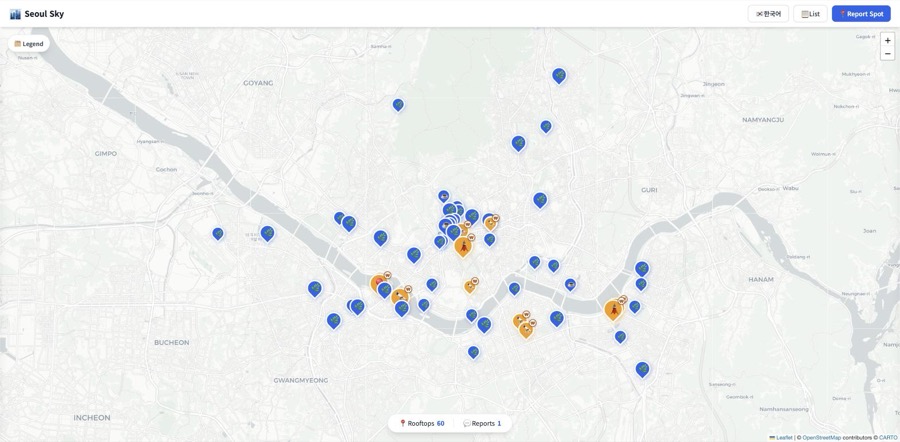
Seoul Sky has 90 places, and 78 of them are free. They are not all rooftop gardens: department store terraces, park viewpoints and hilltop lookouts are mixed in. Tap the "Night View" chip, then open "Legend" and switch off "Paid" under Fee, and you are left with 54 free places that are open in the evening.
If you don't want to think about opening hours, these are open around the clock:
- Seoullo 7017 Sky Garden (Jung-gu, Seoul Station exit 3): open 24/7, year-round, with views toward N Seoul Tower and Sungnyemun Gate.
- Nodeul Island 3F Rooftop Terrace (Yongsan-gu, Nodeul Station): the outdoor terrace is open 24/7.
- DDP Grass Hill Rooftop Park (Jung-gu, Dongdaemun History & Culture Park Station): open 24/7.
- Naksan Second Observatory Plaza (Jongno-gu, Hyehwa Station exit 2): open 24 hours.
Until about 8 pm, department store rooftops work too. The Hyundai Department Store Cheonho 13F Sky Garden and the Shinsegae Gangnam 11F S Garden are both listed at 60 m, and open until 20:00 Monday to Thursday and 20:30 Friday to Sunday.
Here is how the free spots compare with the paid observation decks. Heights and prices are the figures given in Seoul Sky.
| Place | Height | Price |
|---|---|---|
| Lotte World Tower Seoul Sky | 500 m | Adults 31,000 KRW |
| N Seoul Tower Observatory | 236 m | Adults 29,000 KRW |
| SEOULDAL balloon, Yeouido | 130 m | Adults 25,000 KRW |
| 63 Sky Picnic | 249 m | Adults approx. 18,000–20,000 KRW |
| AK Plaza Hongdae 17F Musinsa Terrace Park | 70 m | Free (app check) |
| Sindorim Techno Mart 14F Sky Park | 65 m | Free |
| Jeongdong Observatory, 13F | 50 m | Free |
Seoullo 7017 turns up on three of these maps. Seoul Sky lists it as a 24-hour rooftop, Walking Architecture as the 1970 overpass that MVRDV turned into a raised garden in 2017, and BTS MAP as a filming location for the Seoul tourism film "Seoul Life" and the "With Seoul" music video. One stop covers all three.
Finding a free exhibition today
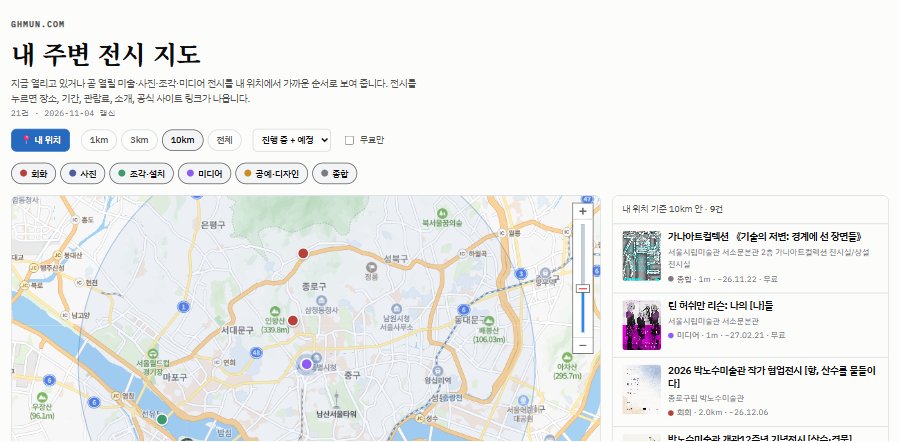
Exhibitions Near Me is fully in English. It pulls exhibitions once a day from the Seoul Open Data Plaza cultural events feed and the Seoul Culture Portal. The 12 November data has 597 entries; on 13 November, 486 of them were open, and 295 of those were free. Museums outside Seoul are included as well, so counting Seoul only gives 195 open exhibitions, 119 of them free.
Press "Near me" to sort by distance (without location access, distances are measured from City Hall). "Search & filters" opens the radius chips (1 km, 3 km, 10 km, All), a period menu, a "Free only" box and genre chips. If you are only in town for a few days, choose "Ending within 7 days" in the period menu to see what closes this week.
A few free Seoul exhibitions from the 13 November data that run for months:
- Opening of the Oegyujanggak Uigwe Room: National Museum of Korea, until 31 December 2027.
- Lynn Hershman Leeson: Seeing Many of Me: SeMA Seosomun, until 21 February 2027. Tuesday to Thursday 10:00–20:00, Fridays until 21:00. It is the last stop of the Jeongdong walk above.
- Contemporary Craft Donation Special Exhibition Equinox: Seoul Museum of Craft Art, Building 1, 3F, until 7 March 2027. Closed Mondays.
- Garden Project: Things Being Engraved: the 63 Oudolf Garden at Centre Pompidou Hanwha, until 7 March 2027.
- Collection exhibition: Oh Yoon: SeMA Art Archives, Moeum Building 1–2F, until 14 February 2027.
Entries marked "Unverified" have not yet been checked against an official source. Use the official link in the detail view to confirm the dates and venue before you go.
If you came after reading a Korean novel
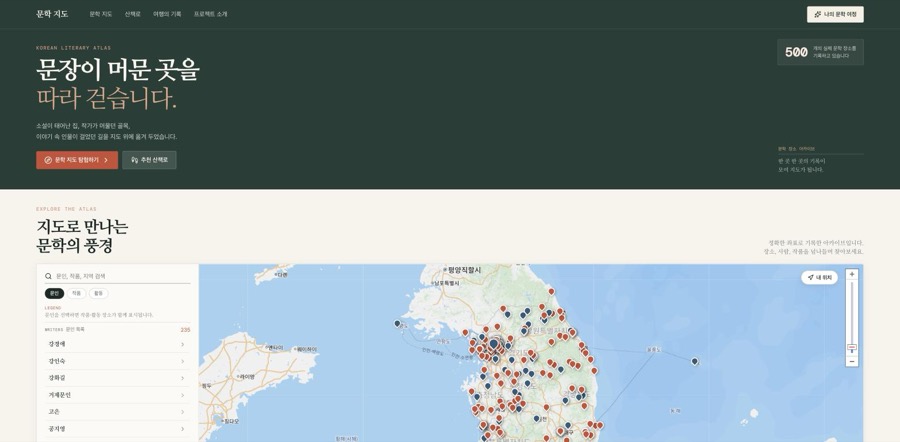
The Literary Map has 361 writers, 731 works and 1,945 places, 641 of them in Korea. Press "EN" to switch to English (the ?lang=en link above does the same). The walks in Seoul are under "Routes".
- Seongbuk-dong Writers' Alley: the houses and house sites of Kim Kwang-seop, Cho Ji-hun, Yi Tae-jun and Han Yong-un, east to west. Suyeonsanbang, where Yi Tae-jun wrote "Moonlit Night" (1933) and "The Stone Bridge" (1943), and Han Yong-un's Simujang are still standing; Kim Kwang-seop's and Cho Ji-hun's houses survive only as sites. The Seongbuk Modern and Contemporary Literature Museum is on the way.
- Park Wan-suh's school route from "Who Ate Up All the Shinga?": from Dongnimmun Yeongcheon Market by Independence Gate, past the gate and the site of her old house in Hyeonjeo-dong, over the Inwangsan section of the city wall to Maedong Elementary School.
- Walking Along "Wings" and Walking Gyeongseong with Kubo: Gyeongseong Station, the Mitsukoshi store, Gwanggyo and Hwasin from Yi Sang's "Wings" (1936) and Park Tae-won's "A Day in the Life of Kubo the Novelist" (1934).
Every place is marked "Still standing", "Changed", "Reconstructed" or "Gone, site remains", so you know what to expect before you go. Gyeongseong Station in these stories is today's Culture Station Seoul 284; Walking Architecture dates it to 1925 and credits Tsukamoto Yasushi. The Mitsukoshi store is now the main building of Shinsegae Department Store (1930), and the store's new wing has a free 6th-floor rooftop, Trinity Garden, listed in Seoul Sky.
If it was Han Kang who brought you here, her places are in Gwangju and Jeju rather than Seoul: Sangmugwan and the former South Jeolla Provincial Office from "Human Acts" (2014), and the Jujeong Factory Detention Center, Jeju 4.3 History Hall, and Pyoseon Elementary School from "We Do Not Part" (2021).
Planning a BTS day
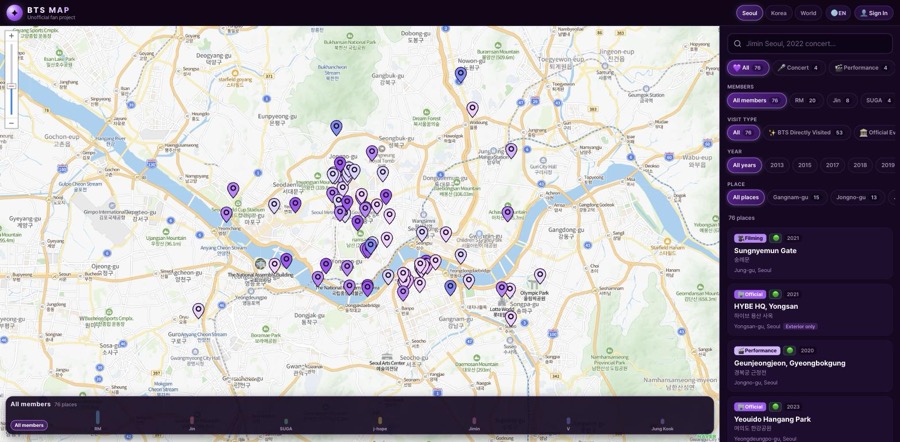
BTS MAP splits its places into Seoul (76), Korea (64) and World (96). Each place has a source attached, and 52 of the 76 in Seoul are confirmed by official sources. It reads your browser language and opens in one of 18 languages, English included. The category filter is the easiest way to split a day:
- Filming: Sungnyemun Gate, where BTS performed "Butter" for Global Citizen Live in 2021. At Gyeongbokgung they played "IDOL" in front of Geunjeongjeon and "Mikrokosmos" at Gyeonghoeru for The Tonight Show in 2020.
- Trainee days: Ilchi Art Hall, where the debut showcase was held on 12 June 2013, Hakdong Park, and the ssambap restaurant Yoojung Sikdang are all in Gangnam-gu. The Cheonggu Building, home of the old Big Hit practice room, can only be seen from outside.
- RM's galleries: MMCA Seoul, Kukje Gallery, PKM Gallery and One and J. Gallery are all in Jongno-gu around Samcheong-dong and Bukchon, close enough for one afternoon.
Visitors cannot enter the HYBE headquarters in Yongsan, and the old HYBE INSIGHT exhibition has closed. Sungnyemun and Hakdong Park are among the 13 sites on the city's official "Map of the Seoul". To send a friend one place, add ?place= and the place's ID to the address, as in the Sungnyemun link above.
Old trees near the palaces and villages you are already visiting
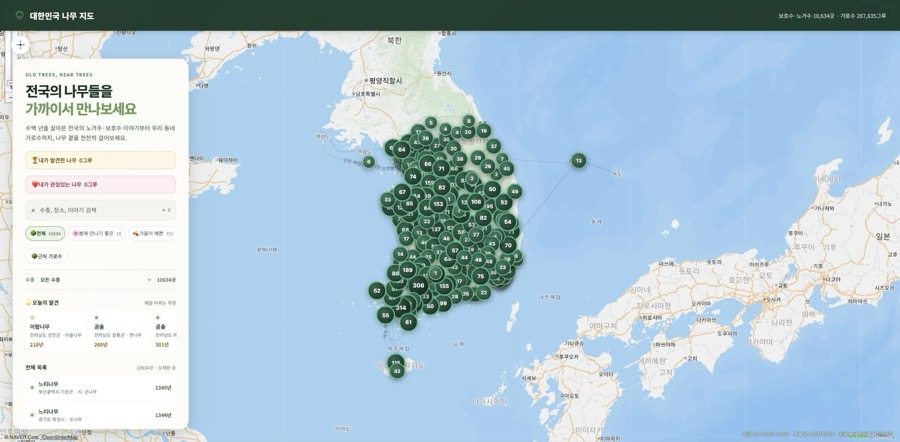
The Korea Tree Map lists 10,634 protected and veteran trees across Korea, 429 of them in Seoul. The screen is Korean-only, but the main controls are simple. The slider labelled 수령 (age) hides trees younger than the value you set; pushed all the way to 1000년 (1,000 years), it leaves 24 trees in the whole country. The menu labelled 수종 filters by species, with names in Korean (은행나무 is ginkgo, 느티나무 is zelkova).
- Sillim-dong, Gwanak-gu: an oriental cork oak, 1,015 years old and 18 m tall, Natural Monument No. 271. The oldest tree in Seoul in this data.
- Banghak-dong, Dobong-gu: a ginkgo, 830 years old and 31 m tall.
- Seocho-dong, Seocho-gu: a juniper, 830 years old and 18 m tall.
- Cheongun-dong, Jongno-gu: a zelkova, 565 years old.
Inside Seoul, the 근처 가로수 (nearby street trees) button shows the street trees around you as green dots once you allow location access. Tapping a pin shows the tree's age, height and girth.
Good to know before you go
- Update cycles differ. Exhibitions are refreshed once a day. On the road closure map, TOPIS data comes every five minutes and the police rally notice every night; the police usually only post the next day's rallies, so later dates show only closures already booked in TOPIS.
- Rally sizes are the numbers the organisers registered. Actual times and routes change on the day.
- Opening hours and prices in Seoul Sky and Walking Architecture can change. Some entries are not open yet: the Sejong Center rooftop observatory is listed only as planned to open by the end of 2026, with no price.
- Languages: Exhibitions Near Me is in English at /en/exhibit; Walking Architecture has English and Japanese; Seoul Sky has Korean, English, Chinese and Japanese; the Literary Map has English; BTS MAP has 18 languages. The road closure map and the tree map are Korean-only.
- How each map was made: Seoul Sky, Exhibitions Near Me, Walking Architecture, Literary Map. If you plan to spend a day on foot, see also A day on foot in Seoul.