I was asked to make a map of places where Korean writers actually stayed. The condition was to include only places recorded with real coordinates, not fictional settings from novels. If the architecture map was "leave out the traditional," this project was "leave out the made-up" — a similar kind of strictness, but it caught me in a different way each time.
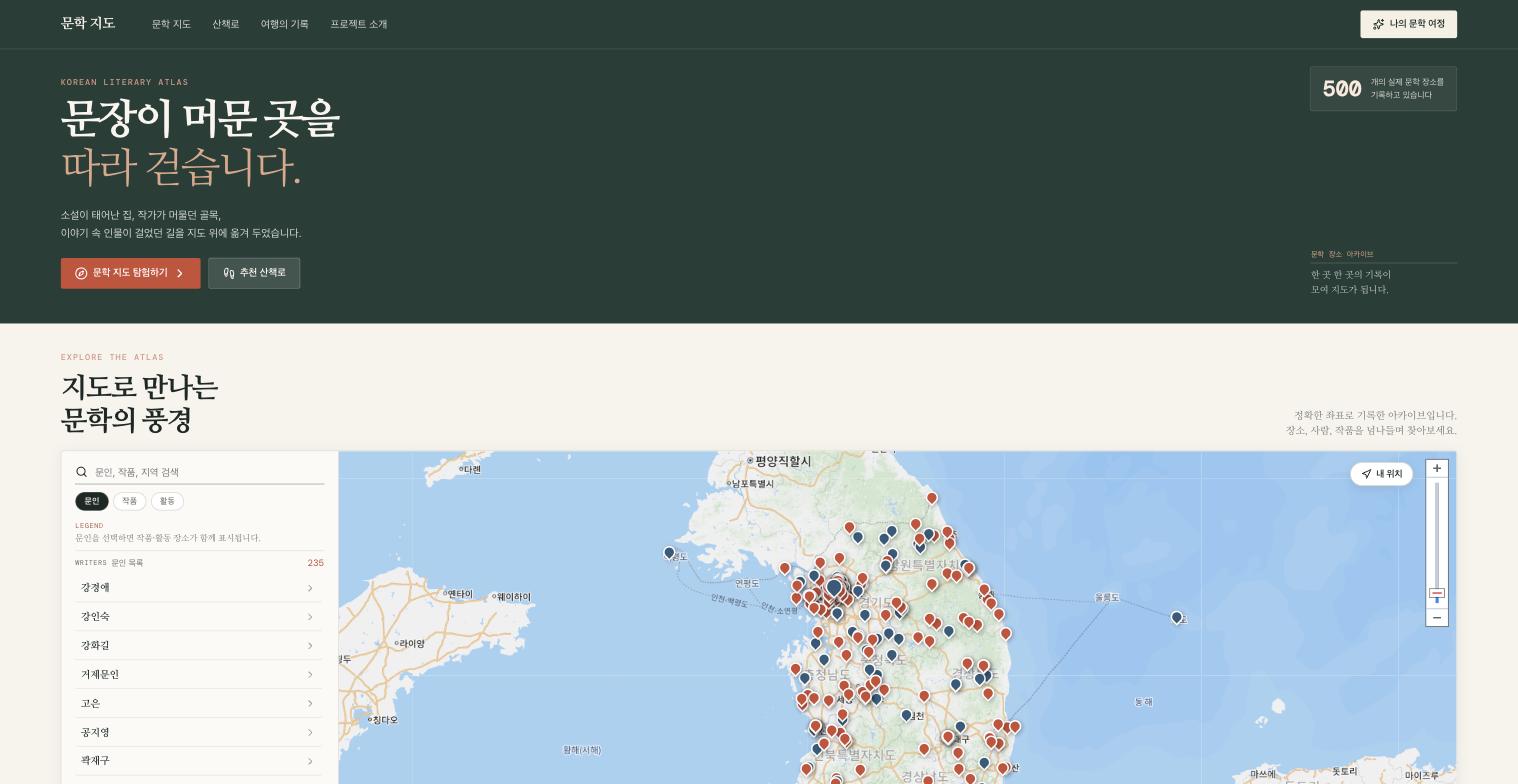
Include both South and North
I was told that covering the history of Korean literature with only the South's story after division would be half the picture. So I made the map's range itself extend up to Pyongyang. If you actually open the map, there are markers in Pyongyang too. Only after hearing "If you only cover writers from the South, it's not a map of Korean literature, it's a map of South Korean literature" did I realize I'd been thinking narrowly from the title alone. There's far less material on writers in the North than in the South, so all I could do was fill it in as accurately as possible with what exists.
The 235 writers had to be split by era
I was told that lining up all 235 writers alphabetically would make the map chaotic. The eras were split into the Enlightenment period, the Japanese occupation, post-liberation, and contemporary, and the filter was to work so that picking one era leaves only the places of writers from that period on the map. Writers active across more than one era (for example, someone who debuted under Japanese occupation and kept writing after liberation) had to show up in both, so the classification took longer than expected.
Mark the evidence for Pyongyang markers separately
Extending the map into North Korea was the plan from the start, but places like Pyongyang are much harder to verify than places in the South. So I was told to give North Korean markers a separate label like "Verification: based on literature," to distinguish their reliability from Southern markers (based on site visits and official sources). The point was "If they look like the same marker, nobody will know the level of verification is different," and I had no rebuttal, so I applied it right away.
Throw out the old project entirely
Before this project there was a separate one called korean-literature. But I was told to throw it out and start over from scratch. New name, new repository. It was exactly the same pattern as with architect, so this time I didn't even ask why and just started a new one. Hearing the same reason a second time, I knew for sure that if this person doesn't like a name, they'll throw out the code without a second thought, however sound it is.
Sometimes two writers shared the same house
A few of the 500 places were houses where two writers from different eras had lived. I thought I could just put both people's stories in one marker, but the request came in: "Clearly separate who lived there first and who lived there later, in chronological order." Lumping it together as "two writers lived in this house" makes it confusing who came first. I rebuilt it so that clicking the marker unfolds the two periods in order inside the card.
Never use the default domain — that was set in stone
If you go to the vercel.app address the deployment platform gives by default, you get a login screen. That's because access is restricted. The actual service is set to open only at liter.ghmun.com. Even when I run the command that checks deployment status, this project alone shows "status unknown," while the site itself runs just fine — I was told to put that in this article too.
How to use it: searching by writer is faster than searching the map
Rather than scrolling around the map yourself, typing a writer's name into the search box at the top is faster. Search highlights every place related to that writer, and the map automatically moves to that location. With an era filter on the left (Enlightenment, Japanese occupation, post-liberation, contemporary), search results are also narrowed to that era. The geographic scope isn't Seoul, Nationwide, or Global but a single combined map of South and North Korea, so there's no need to turn North Korea on or off separately. A pale gray marker means "based on literature" verification, and a dark one means "based on site visit" verification. For a marker where two writers shared a house, opening the card splits it into two stories, first the earlier resident, then the later one.