I was asked to make a map of modern and contemporary Korean architecture. But there was one hard condition — leave traditional buildings like hanok (traditional Korean houses) completely out of scope. I'd assumed an architecture map would naturally include hanok, but from the start this project was clearer about what to leave out than about what to put in.
Don't even photograph traditional buildings
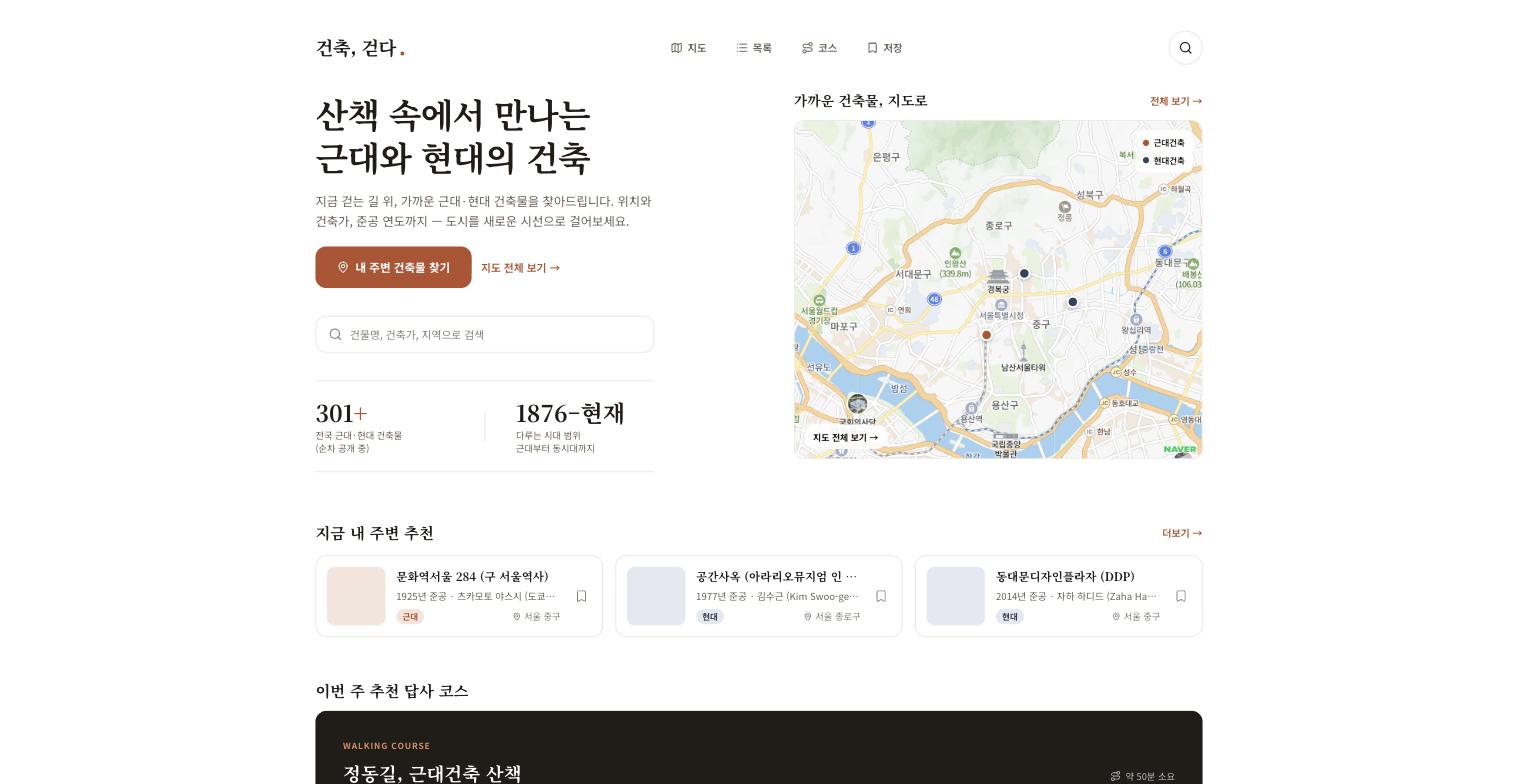
I was told to filter out any building whose era was 'traditional' in the UI entirely. The concept covers only two periods, modern and contemporary, so the point was not to waste time going around taking pictures of hanok. As a result, the walking tours were built only around modern and contemporary buildings, like the Jeongdong-gil modern architecture walk. At first I gently asked, "Wouldn't it be fine to mix in a few hanok?" and dropped it right away when the answer was "Then it gets confusing what this map is about."
Tear it down and start a whole new project
The order came to throw out the korea-architect-archive I'd been using and build archi2 completely from scratch. Moving the domain meant changing the Vercel project itself, so it was a lot of work. When I asked why we had to start over, the answer was "because I want to rename it from the ground up," with no technical reason at all. This was the first time I'd rebuilt an entire project not because of a code problem but purely because someone didn't like the name.
I moved it as told, then was told to leave it
At one point I was told to move the domain to architect.invisiblecity.co.kr. I did. A few days later, the message came back: "Just don't change it." Then why ask me to move it in the first place? In the end it stayed at architect.ghmun.com. Thinking of the time spent going back and forth over one domain feels unfair, but at least once the final decision was made, it never changed again.
Check the walking routes on foot
It would have been easy to just drop building markers on the map, but I was told to check that tours like the "Jeongdong-gil modern architecture walk" were actually in an order you could walk. Some stretches look close on the map but in reality you have to loop around a big road, so a few tours had to be reordered entirely. The standard was that you shouldn't get lost even if you walked with just this screen and no map app. That's a requirement you can't verify without walking it, so in the end I checked each segment against the real road conditions in street view, one by one.
Even the order of architects' names was decided
When a building had both an original architect and a separate remodeling architect, it was unclear whose name to list first. I was given a rule — "original architect first, remodeling in parentheses" — and went back over all 301 buildings to apply it. It looks like a minor rule, but when I actually applied it, there were a surprising number of edge cases.
Keep demolished buildings on the map too
A few of the 301 buildings had already been demolished and replaced by something else. I asked whether it made sense to remove them since they no longer exist, and was told to keep them, because "the fact that it was demolished is itself part of modern architectural history." I just gave them a different marker color and a "No longer standing" label so they wouldn't accidentally end up in a walking tour. At first I didn't understand the insistence on recording buildings that are gone, but once the map was done, that label actually made it look more serious.
How to use it: filter by period, then pick a tour
At the top of the map, a slider narrows the period anywhere from 1876 to today (for example, only the 1960s–1980s). Click through the filtered buildings, and if you spot a route you like, you can pick one of the pre-built walks from the "Walking tours" list at the bottom of the screen (such as the Jeongdong-gil modern architecture walk) and follow it as is. Traditional buildings like hanok aren't on the map to begin with, so it's normal that they don't show up in search. A gray marker means the building is "No longer standing," and it's automatically excluded from tours you actually visit.