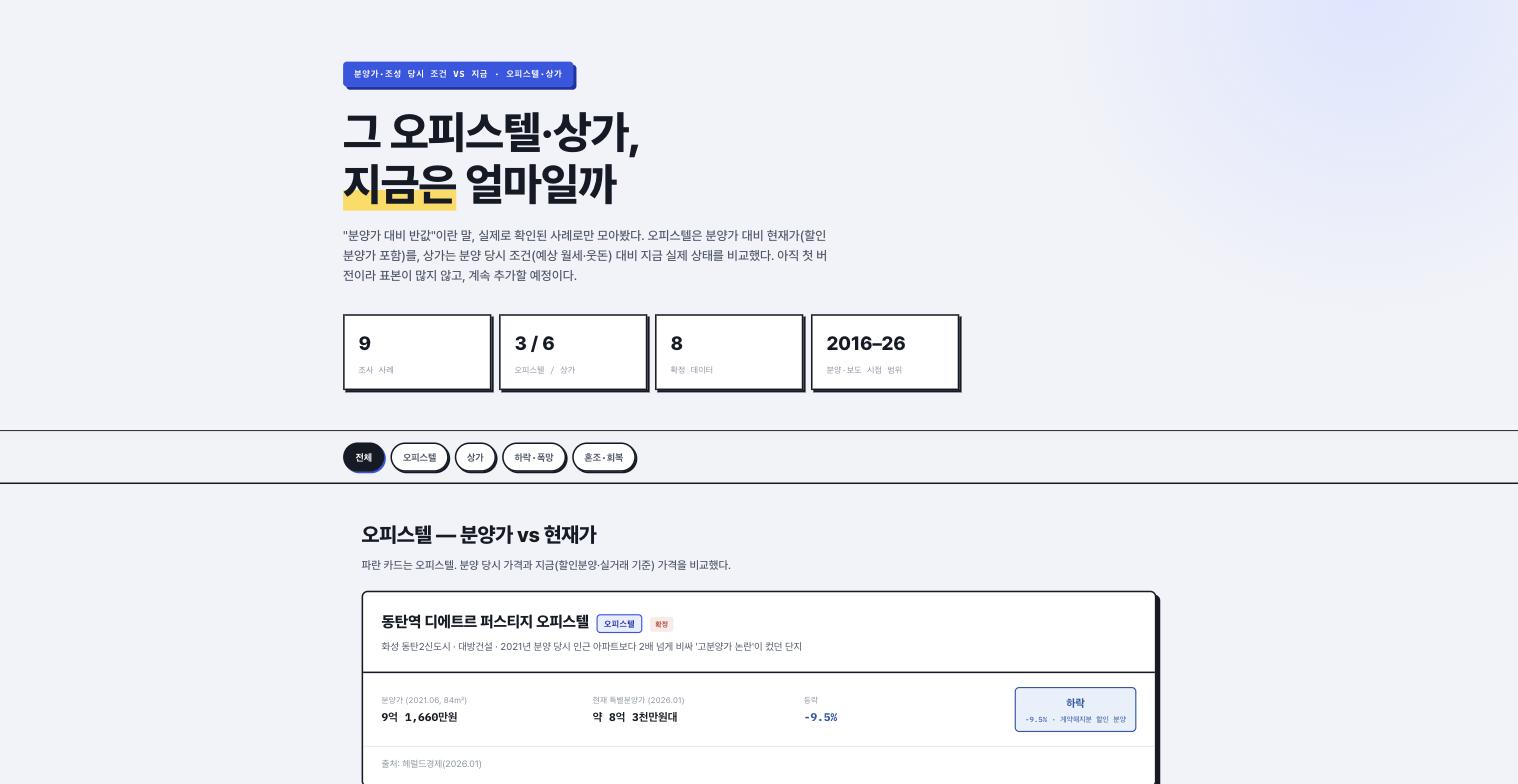
After the apartment lottery project, I was asked to make a version for retail units and officetels (studio-style units sold like apartments). The condition was to collect only cases where "half the original sale price" actually checks out. The problem was that retail units don't compare as neatly as apartments. In the cheongyak (Korea's lottery system for new apartments) project, one number decided win or loss. This time I first had to work out what even decides win or loss.
I was told officetels and retail units compare on different terms
Officetels can be compared on current price against sale price (including discounted sale prices). Retail units, I was told, have to compare the rent and yield expected at the time of sale with how they're actually leased now. That meant two comparison standards for one asset class, so the card layout had to be redone from the start. After hearing "If you lump it into one number, you're only telling half the retail story," I dropped my plan to reuse the cards from the apartment lottery project as is.
Wirye, Misa and Garden Five were harder because they're retail
Unlike officetels, news about vacancy rates and falling rents for the Wirye, Misa and Garden Five retail units is scattered across local online forums and news articles, so pinning down even one number meant cross-checking three or four sources. Garden Five in particular is famous for its vacancy problems right after completion. I asked, "Isn't that something everyone knows?", and the answer was to source it even more carefully. The logic: the more everyone knows something, the harder you get hit when you get it wrong.
The Dongtan, Sangbong and Changdong officetels split on location
Among officetels, Dongtan has a station-area premium, while Sangbong and Changdong are relatively weak. I was told not to lump them together as "officetels are all bad," and to add at least a line or two on each card explaining why the outcome differed by location. There are only 9 cases, but adding context sentences to every card made for a lot of work relative to the sample size.
There was no way to check lease status directly
Retail rents have no public system the way apartment transaction prices do. I had no choice but to estimate "this is roughly what it's leasing for now" by cross-checking local real estate forum posts, asking prices on rental listing sites, and the occasional article about retail units. Knowing this isn't as accurate as the apartment data, I added a separate label to the retail cards: "Estimate · cross-checked across sources." I was told yet again, "Saying it might be inaccurate is better than pretending to be accurate." By now it was clear that this person's principles don't change from project to project.
I had to say plainly that 9 cases is all there is
I was told to put this line on screen as is: "This is the first version, so the sample is small, and more will be added." Instead of hiding how few cases there are, the choice was to admit it and write down that it will be filled in later. It's the same kind of demand as "publish your survey criteria" in the apartment lottery project, but this time the sample itself is small, so there was extra pressure to be even more upfront.
I was told to put the overpriced-launch complex up front, on purpose
The Dongtan Station Dietre Firstige officetel was priced at more than twice the nearby apartments when it launched, which caused a big "overpriced" controversy. It's now down 9.5%, and I was asked not to hide it but to put it in the front row. Wanting good cases up front is the natural reaction, but here too I heard, "If you hide the bad cases at the back, why make this table at all?" After the third time, that logic feels almost like a rule.
How to use it: pick the asset type first
At the top of the screen, first pick the Officetel (3) or Retail (6) tab. For officetel cards, one line comparing current price to sale price (including discounted sale prices) is enough. Retail cards need two lines read together: "expected yield at time of sale" and "actual lease status now." Different asset types mean different comparison standards, so don't read the two tabs the same way. Tap the "Small sample" badge at the bottom of a card to preview the list of candidate cases to be added. The "Estimate · cross-checked across sources" label on retail cards means the lease value is not an official statistic but an estimate from cross-checking several sources.