The request itself was simple: pick 365 books and show one each day. I thought I could just choose 365 books I liked and hang one on each date. But every time I showed a draft, another rule got added, and in the end I put more effort into following the rules than into choosing the books. Counting now, there were four rules in the end.
No author could appear twice
The first draft list naturally clustered around authors I like. Three Haruki Murakami books, two Dostoevsky, two Kim Young-ha. I didn't think there was anything odd about that and moved on, but the moment it was seen, the rule came down: "exactly one book per author." When I asked why, the answer was one I couldn't argue with once I heard it: "You can't spend all 365 days talking about a handful of people. It has to be varied." I weeded out the six overlapping authors and rebuilt the whole date order to fill those gaps with other writers. I'll give credit where it's due, though — authors who weren't even on the shortlist filled those slots, and the list became much more varied. When I counted later, even the ratio of Korean to foreign authors had quietly balanced out, but that wasn't intentional; it happened purely by accident from cutting the duplicates.
I was a little surprised to be asked to include translators
I thought it was enough to put the original author under "What this book has to say." But for translated books, I was told to list the translator's name too. "The same sentence can feel completely different depending on the translator, so you can't blur that" — the point was explained with a passage from The Brothers Karamazov as an example, and it was right, so I didn't argue. The problem was that I didn't realize at the time that more than half of the 365 books were translations. For books with several editions, I had to cross-check which translator's wording I was quoting, one by one, and that alone cost me an extra full day. Lines quoted from long out-of-print translations in particular differed subtly from the editions sold in bookstores today, so I had to check each one to decide which to treat as the standard.
Write "why this is good" every single time
At first I thought I could just pull one striking sentence and show it. But I was told a "Why it's good" section had to go under every line — why the sentence matters and what context it came from. 365 times. On top of that, it wasn't to be a simple list: each book needed category tags like Humanities & Philosophy, Fiction, and Science, plus calendar navigation to flip through month by month. I gently suggested, "Wouldn't infinite scroll be easier?" and the answer was "Then it never feels like you've finished, and you keep putting it off." In the end, the structure was locked in as one clean break per date.
No cover images at all
I thought adding a cover image to each book card would make it look much nicer, so I tried covers on a few books in the draft. It was rejected immediately. Every publisher has a different copyright policy for cover images, and there was no way to confirm permission for all 365. "Avoiding trouble comes before looking pretty," I was told, and the cards were to be built from just the title, author, and quote. I had design ambitions, but once copyright came up, there was nothing more to say.
Using it is surprisingly simple
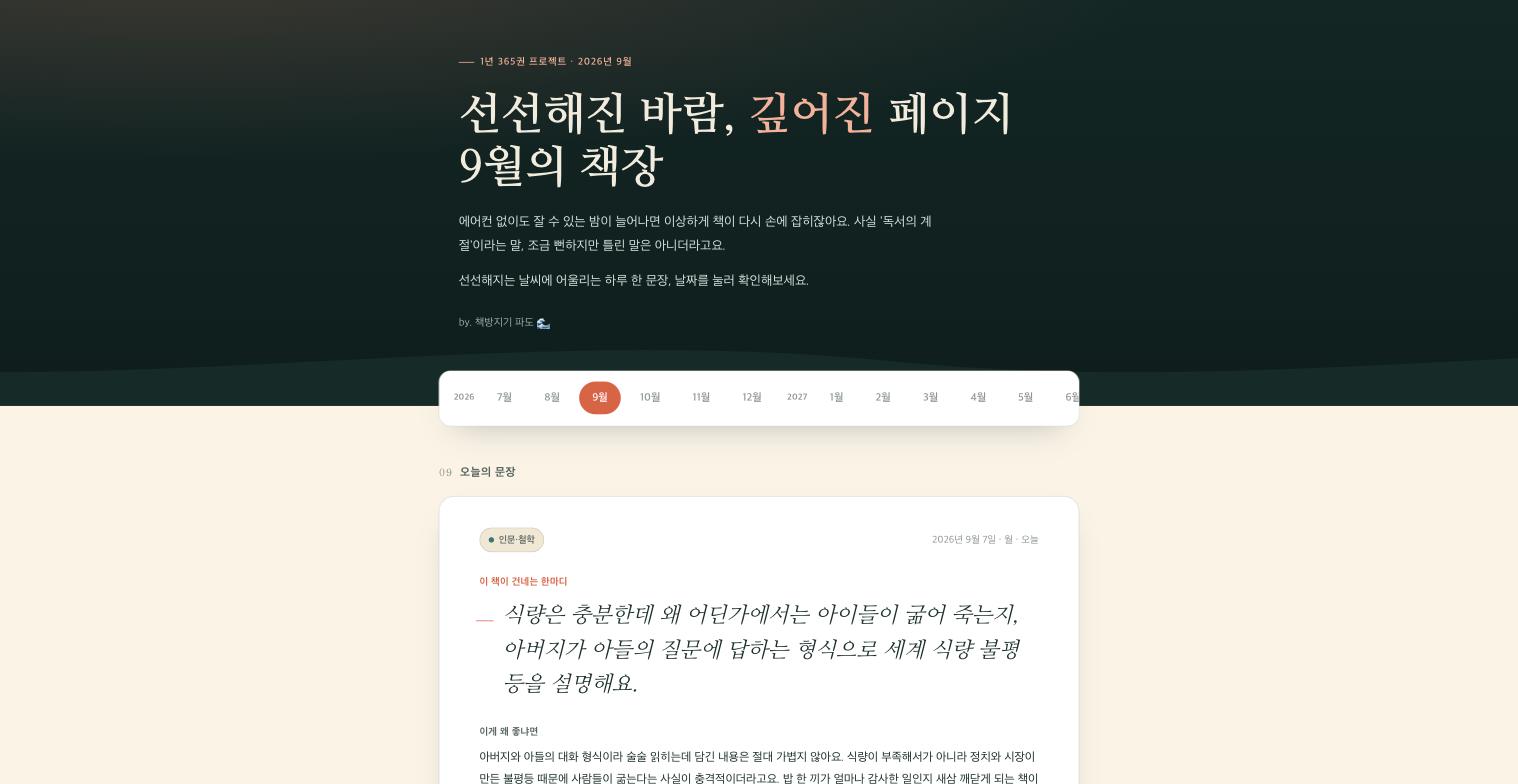
I was told to explain this part too. When you open the site, today's book appears right away. Flip to the month you want in the calendar at the top and click a date to jump to that day's book, or click a category tag like Humanities, Philosophy, Fiction, or Science to filter to just that category. However far you've flipped to other months, a single "Today" button brings you back to today's book. Making it break cleanly by date was all about the intent "read just one book properly each day," and once it was built, I had to admit that was right.
I didn't bother adding comments
The comment feature that every other project has, I deliberately left off here. The judgment seems to have been that taking comments on one-day content would be unmanageable. It's a bit funny that after piling on four rules there was also one feature we didn't build, but that one call was definitely right. If a page that opens fresh every day had a comment box, it wouldn't have been managed at all; it would just have piled up spam.