Reading · Ideas · Making-of
E-reader Comparison
From Kindle to Crema to BOOX — every e-reader released, side by side.
About this project
What it is
This page gathers the specifications of 82 e-reader models, from the first Kindle in 2007 to products released in 2026, in one comparison. An e-reader is a dedicated device that shows books on an e-ink screen. It covers 13 brands: three Korean ones (Ridi, Kyobo Book Centre's SAM line and Aladin's Crema) and ten overseas ones (Kindle, Kobo, BOOX, PocketBook, tolino, reMarkable, Huawei, Xiaomi, Lenovo, Ratta). It is meant for someone who wants to see when things appeared, what changed over time, and which models to look at for a given use. Each model lists release year, screen size, weight, waterproofing, storage, launch price, colour or monochrome, whether it runs Android (so you can install any reading app) and a one-line editorial comment.
How to use it
- Chips at the top: All, Korean, Overseas, Waterproof, Colour e-ink. These chips and the sort menu (newest, oldest, lightest, brand name) affect only the brand cards at the bottom of the page.
- "Browse by year": click a model under its year to jump to its brand card. Blue marks Korean brands and red marks overseas ones; side buttons page through the years.
- "At a glance" is a table with its own filters: brand, release-year range, screen size (6, 7, 8 or 10+ inch), monochrome or colour, Android or dedicated device, waterproof, and a weight range in grams, plus a reset button. It shows 15 rows at a time and can be expanded.
- Tick two models in that table to open a side-by-side panel that highlights the rows where they differ. Ticking a third drops the one you picked first.
- "What should I look at?" has six use cards (novels, comics and magazines, study and handwriting, multiple apps, bed and bath, commuting). Clicking one applies matching filters to the table above.
Data and method
Specifications come from manufacturers' and retailers' announcements and product pages, Danawa (a Korean price-comparison site), YES24 and Kyobo material, and official Amazon, Kobo and BOOX specifications, supplemented in places by review sites such as Notebookcheck; many models carry their own source note. Of the 82 models, 39 have some value (weight, price, storage) that could not be confirmed from an official source and are marked "*estimate"; hovering over the value shows the basis. A model is called waterproof only when an official rating such as IPX8 or IP67 is stated. The Korean-won figure next to prices in dollars, euros or yuan is a rough reference using fixed rates (1,420 won per dollar, 1,640 per euro, 210 per yuan). Launch prices are those at first announcement and exclude promotions. The one-line comments are editorial, not specifications.
Limits and caveats
- This is not a complete catalogue. It leans on representative models per brand, and reMarkable, Huawei, Xiaomi and Lenovo have only one or two models each.
- All 13 models from before 2020 are estimates based on general knowledge. Another 26 models from 2020 onward also carry an estimate mark, so the header line saying everything from 2020 on is source-checked is more optimistic than the page's own markings.
- Weight is shown only in grams, without the original unit.
- Prices vary with date, exchange rate and seller, so check the manufacturer's official specification before buying.
- This is a reference for comparing specifications, not a review or a buying recommendation.
Related
- Books - another project for readers
The request was to catalogue e-reader models from 2007 to now. The page currently lists 92 models from 14 brands, Korean and foreign, from black-and-white to color e-ink. It looked like a one-spec-table job. It did not take long to learn that there is no good way to confirm the specs of a 2007 reader today.
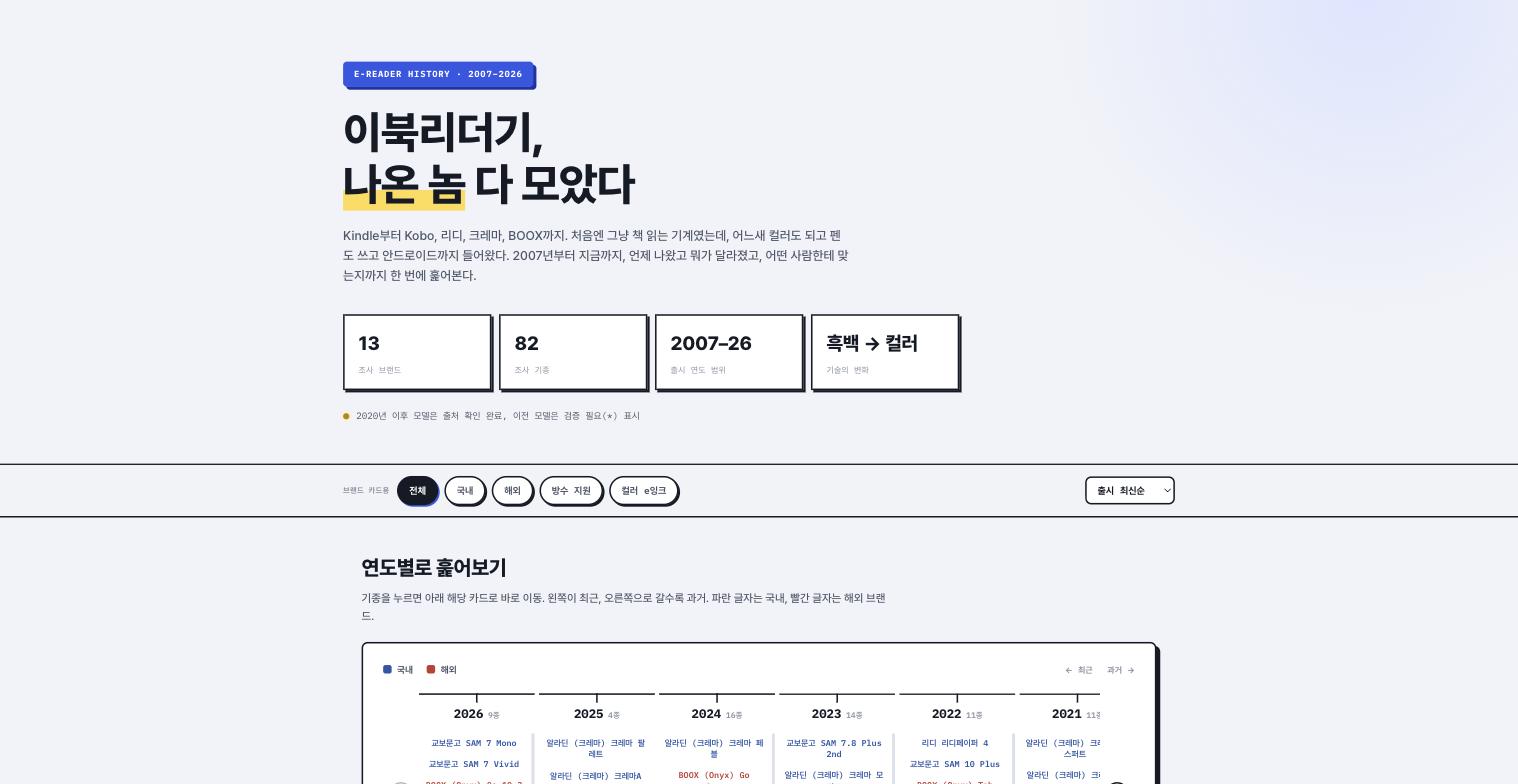 The screen when it had 13 brands and 82 models. Ten Bigme models were added in November 2026, making it 14 brands and 92 models
Unverified values stay marked
For older models the launch press releases have been deleted, or the specs are written differently in different places. I tried to fill the gaps with plausible values and was told no. Models from 2020 on are marked "source confirmed," earlier ones "needs verification," and the badges stay on screen. I asked whether that would make the page look unfinished, and the answer was the opposite. The green and gray badges at the top right of each card are the result.
When the list was first compiled, the price of the Kyobo SAM 7 Mono and Vivid had not been announced, so those fields were left empty. I could not write in an estimate, so they said "price TBA" and kept their place in the list. They were filled in September 2026, once Kyobo listed the price on its product page.
Units and logos
Korean models list weight in grams while some foreign models give only ounces. I converted to one decimal place and kept the original unit in parentheses. More than twenty models were in ounces, so this alone took half a day. The parentheses make it easier to check against the original spec sheets.
My first draft put brand logos such as Kindle, Crema and BOOX on every card. They were all removed over trademark concerns, and brands appear as text only. A color tag next to each brand name keeps the list easy to scan.
How many to compare
Showing dozens of models in one view is unreadable, so you tick the models you want and a comparison table appears at the bottom. I asked how many should be allowed at once and got "four should be enough." After trying it, the user said three is too few and five too many, so four became the limit. The table has since been redesigned: you now tick two models and compare them side by side. On the year timeline, blue text marks Korean brands and red text foreign ones.